Great biopics do more than recount events—they interrogate legacy. They confront contradiction, humanize myth, and honor both triumph and tragedy. The recent Michael Jackson movie does none of these. Instead, it operates as a hollow tribute, a glossy highlight reel that mistakes reverence for storytelling. The failure isn’t just artistic—it’s ethical. By sidestepping the core duty of a biopic, it misleads audiences, disrespects history, and diminishes Jackson’s own complexity.
What a Biopic Ought to Do—And Why This One Doesn’t
A successful biographical film must balance admiration with accountability. Consider Ray, which portrayed Ray Charles’s genius while not flinching from his struggles with addiction and infidelity. Or Bohemian Rhapsody, which—despite flaws—still acknowledged Freddie Mercury’s identity and mortality.
The Michael Jackson movie, however, treats scrutiny as sacrilege. It presents Jackson as a perpetually wronged child-king, dancing through life surrounded by vultures. Lawyers, media, accusers—they’re all faceless antagonists. Jackson himself is stripped of agency, not just in his suffering, but in his choices. There’s no exploration of how his behavior alienated collaborators, confused fans, or raised legitimate questions.
The film’s core betrayal? It assumes admiration requires erasure.
Evading the Allegations: Not Just a Missed Opportunity—A Breach of Trust
No honest portrayal of Michael Jackson can ignore the allegations made during his lifetime and after. The 1993 accusations, the 2005 trial, and the renewed scrutiny from documentaries like Leaving Neverland are not side notes—they are central to understanding his legacy.
Yet the film reduces these issues to background noise. A brief courtroom scene. A few tense exchanges. No weight. No context. No attempt to show how these events shaped Jackson’s psychology, relationships, or public standing.
This isn’t discretion. It’s deception.
By refusing to engage, the film sends a message: we don’t need to talk about this because we’ve already decided what’s true. That’s not storytelling—it’s spin. And it undermines trust with viewers who deserve better than a PR campaign disguised as cinema.
Flattening the Man Behind the Myth
Jackson was never just a performer. He was a meticulously crafted persona—part innocence, part spectacle, part isolation. His fashion, his speech, his relationships—all were performance, yet the movie treats them as natural.
We see him dancing, recording, rehearsing. But where is the man behind the glove?
There’s no exploration of his fraught relationship with his father. No reflection on his changing appearance—beyond a single line about vitiligo. No dive into his financial recklessness, his obsession with youth, or his deep-seated need for control. These aren’t gossipy details. They’re psychological anchors.
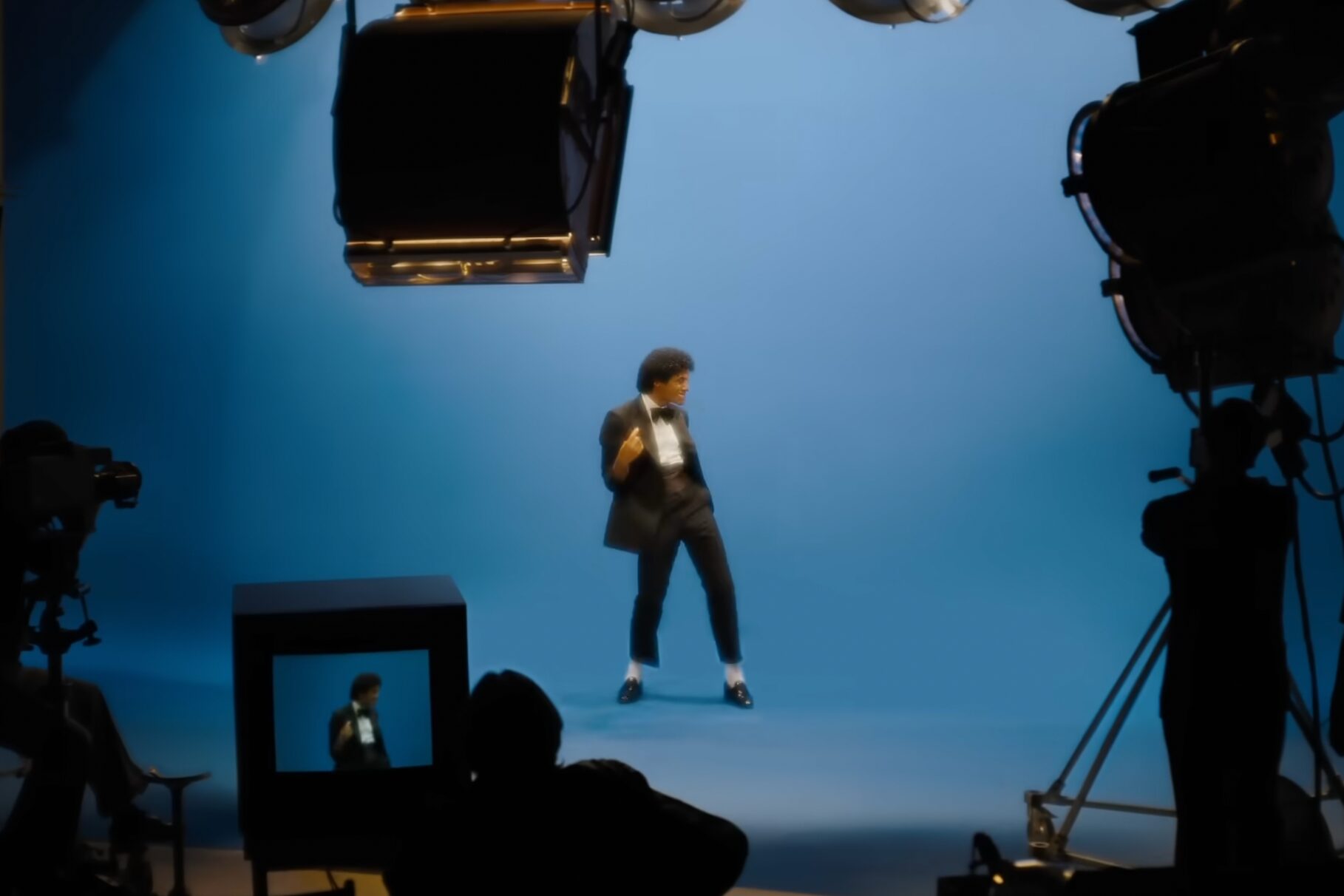
The film instead offers a museum exhibit: Michael Jackson, perfectly preserved, never evolving, never contradictory.
It’s the equivalent of showing Picasso’s Blue Period without mentioning war, grief, or poverty. The art is there—but the soul is missing.
Aesthetic Over Authenticity: Style Without Substance
Visually, the film is impressive. Costumes are spot-on. Dance sequences are recreated with fanboy precision. The music—of course—is transcendent.
But technical excellence can’t compensate for narrative cowardice.
One extended sequence recreates the Thriller shoot with frame-for-frame accuracy. The makeup, the choreography, the fog—it’s flawless. But what does it tell us? That Jackson could direct a music video? We knew that.
Compare this to Control, the Joy Division biopic that used black-and-white visuals and minimal dialogue to mirror Ian Curtis’s emotional repression. Or Walk the Line, where Johnny Cash’s turmoil was reflected in the film’s pacing and sound design.
Here, style serves only to dazzle, not to reveal. The film mistakes spectacle for insight.
The Estate’s Influence: When Legacy Management Becomes Censorship
It’s no secret that the Jackson estate approved and likely shaped this film. That’s not inherently wrong—estates have a stake in how icons are portrayed. But when approval comes at the cost of honesty, the result isn’t a biography. It’s branding.
Consider the film’s portrayal of Sony executives. They’re cold, greedy, dismissive—while Jackson is the visionary unfairly constrained. But real history is messier. Jackson renegotiated his contract for an unprecedented $65 million and owned half of Sony/ATV’s publishing catalog—a power move, not a victim’s plea.
The film omits this. It omits his mounting debts. It omits his last-ditch gamble with the This Is It concerts. Why? Because complexity doesn’t fit the martyr narrative the estate prefers.
When a biopic serves estate interests more than audience understanding, it ceases to be art. It becomes advocacy.
Why Fans Deserve Better
Jackson’s fans aren’t monolithic. Some defend him unconditionally. Others mourn the art while condemning the actions. Many sit in the uncomfortable middle.
This film refuses to acknowledge that spectrum. It demands allegiance, not reflection. It offers no space for grief, doubt, or critical love.
A better film would have allowed that tension. It might have opened with a montage of children from Leaving Neverland speaking—then cut to a young Jackson dancing in the Jackson 5. Not to equate them, but to force the audience to sit with discomfort.
Great art doesn’t resolve contradiction. It holds it.
Instead, this film hands viewers a simplified saint, wrapped in sequins and sorrow. It’s emotionally manipulative—and artistically bankrupt.
Comparing the Approach to Other Music Biopics

| Film | Treatment of Controversy | Legacy Impact | Viewer Trust |
|---|---|---|---|
| Ray | Directly addresses drug use, infidelity | Deepened appreciation | High |
| Bohemian Rhapsody | Glosses over Mercury’s HIV timeline | Mixed | Moderate |
| Walk the Line | Explores addiction, volatility | Enhanced emotional depth | High |
| The Dirt | Glorifies excess without critique | Criticized for irresponsibility | Low |
| Michael Jackson Movie | Avoids all hard truths | Undermines credibility | Very Low |
The pattern is clear: biopics that confront flaws earn respect. Those that sanitize are forgotten—or mocked.
This film chooses the latter path. And in doing so, it disrespects not just history, but the intelligence of its audience.
The Cost of a Failed Biopic When a biopic fails, the cost isn’t just box office. It’s cultural.
Younger viewers unfamiliar with Jackson’s story may walk away thinking the allegations were media fabrications. Casual fans may deepen their blind loyalty. Survivors of abuse may feel erased.
And Jackson himself? Reduced to a cartoon. A victim. A spectacle. Again.
The tragedy isn’t just that the film got Jackson wrong. It’s that it had a chance to help us understand him—and chose not to.
Closing: Demand Better from Biographical Films
We don’t need every biopic to be an exposé. But we do need honesty. We need films that respect the audience enough to say: this person was brilliant and broken. Loved and destructive. Human.
The Michael Jackson movie fails that duty. It’s not a biography. It’s a eulogy dressed as cinema.
Next time, we should expect more. Not just for Jackson—but for the genre, the audience, and the truth.
FAQ
Why is the Michael Jackson biopic considered a failure? It avoids addressing serious allegations and complexities in his life, opting for a sanitized, one-dimensional portrayal that prioritizes image over truth.
Does the movie mention the abuse allegations? Minimally. It references them in passing but offers no depth, context, or exploration of their impact on Jackson or his victims.
Who was involved in making the film? The Jackson estate was heavily involved, which likely influenced its protective, defensive narrative.
How does this biopic compare to others like Ray or Bohemian Rhapsody? Unlike those films, which confront their subjects’ flaws, this one evades controversy, making it less credible and emotionally shallow.
Can a biopic honor an artist without ignoring their flaws? Yes—films like Ray and Walk the Line prove that showing both genius and weakness creates deeper, more respectful portrayals.
What should a Michael Jackson biopic have included? A balanced look at his artistry, relationships, changing identity, financial issues, and the abuse allegations—with space for audience reflection.
Is it possible to appreciate Jackson’s music while criticizing the film? Absolutely. The music stands apart. The film’s failure is in storytelling, not in celebrating his artistic achievements.
FAQ
What should you look for in The Michael Jackson Movie Fails at the Basic Duty of a Biopic? Focus on relevance, practical value, and how well the solution matches real user intent.
Is The Michael Jackson Movie Fails at the Basic Duty of a Biopic suitable for beginners? That depends on the workflow, but a clear step-by-step approach usually makes it easier to start.
How do you compare options around The Michael Jackson Movie Fails at the Basic Duty of a Biopic? Compare features, trust signals, limitations, pricing, and ease of implementation.
What mistakes should you avoid? Avoid generic choices, weak validation, and decisions based only on marketing claims.
What is the next best step? Shortlist the most relevant options, validate them quickly, and refine from real-world results.